
Disclosure: I purchased the ARC-X myself. I also purchased the ½-inch titanium contact points used during the latter part of this review. Dogtra UK answered my questions during testing, but they did not ask to review or approve this article before publication.
When Dogtra introduced the ARC-X, it was positioned as a compact, modern e-collar aimed primarily at companion dogs and dogs with milder temperaments.
As someone who has spent over 40 years training working dogs, including Belgian Malinois, I wanted to answer one simple question:
Could it stand up to the demands of a high-drive working dog?
Over the past several weeks I’ve used the ARC-X as River’s primary training collar during obedience, recall, distraction work, daily exercise and even beach training.
This isn’t a laboratory review.
It’s based on living with the collar every day.
First Impressions
The first thing that strikes you is the quality.
The receiver is compact, lightweight and sits neatly on the dog’s neck. The transmitter feels solid in the hand, the buttons have a positive tactile feel, and the overall fit and finish are exactly what I’d expect from Dogtra.
Everything about the ARC-X feels well engineered.
It doesn’t feel like a budget collar trying to look premium.
It simply feels premium.
The Initial Problem
Unfortunately, my first impressions weren’t entirely positive.
Very early on I experienced inconsistent stimulation.
One day River would respond consistently at around level 11.
The following day she might require levels approaching 30 before producing exactly the same response.
Clearly something wasn’t right.
Rather than immediately criticising the collar, I decided to investigate properly.
The Testing Process
Over the following weeks I systematically tested every variable I could think of.
This included:
- Collar position
- Collar tension
- Receiver position
- Contact point material
- Contact point length
- Receiver stability
- Different training environments
Rather than guessing, I changed one variable at a time and continued using the collar during normal daily training.
My objective wasn’t to prove the ARC-X was good or bad.
It was simply to discover what was causing the inconsistency.
Test Configuration
For this review, the ARC-X receiver was mounted on a FlexCollars Super Heavy bungee strap rather than the standard Dogtra strap.
The feature that originally attracted me to the Flex Collar was its Austrialpin Cobra buckle. Having used Cobra buckles on working equipment for many years, I trust them completely. They’re exceptionally secure, quick to operate and virtually impossible to release accidentally under load.
The bungee section also provides a degree of constant tension, helping to maintain contact as the dog moves without requiring the collar to be excessively tight.
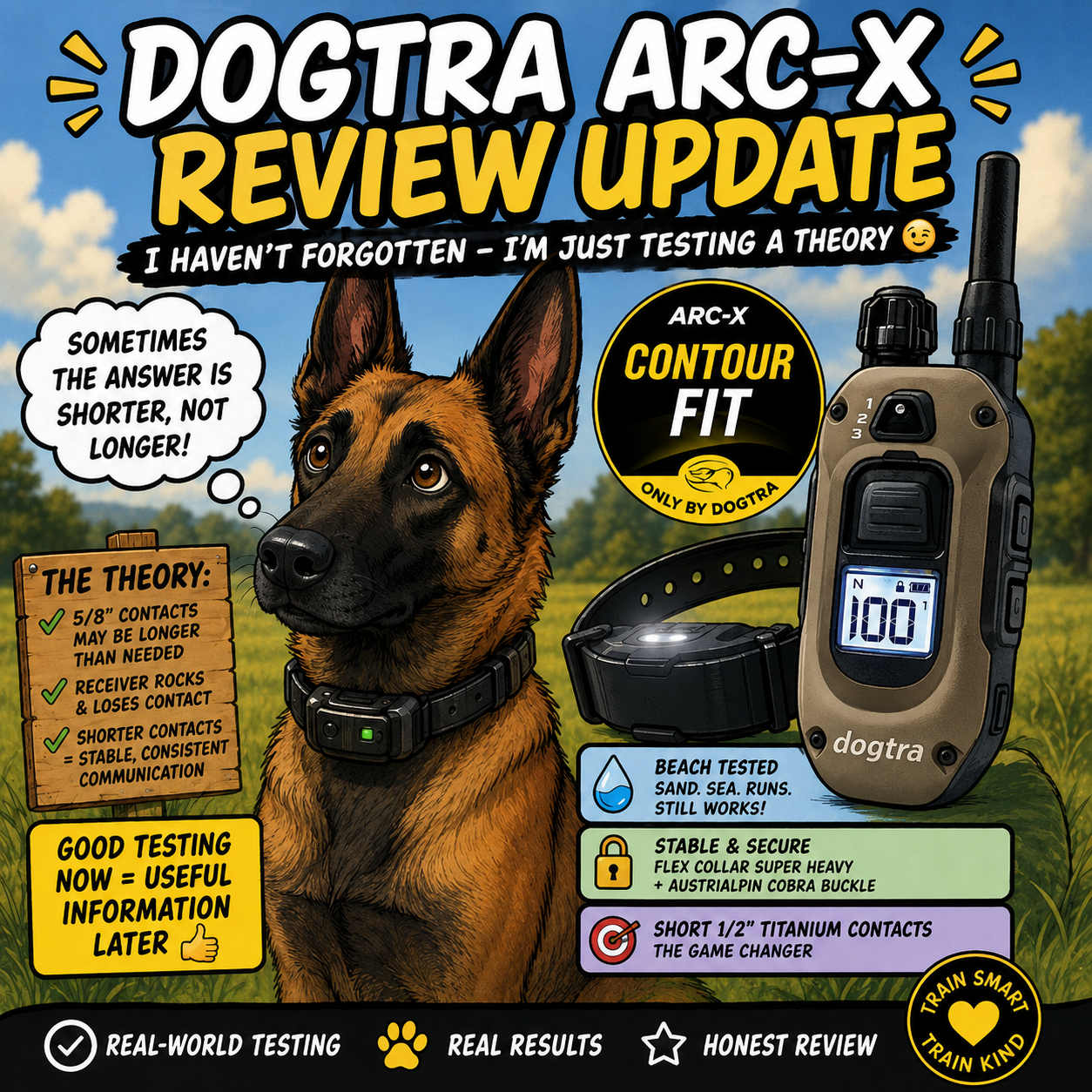
For the latter part of my testing, the receiver was fitted with ½-inch titanium contact points and adjusted to provide a secure but comfortable fit.
This is the configuration used for all of the conclusions in this review.
A Lesson About Contact Points
One assumption I made—and one I suspect many owners make—is that a thicker coat automatically requires longer contact points.
My experience suggests that isn’t necessarily true.
Despite River being a Belgian Malinois with a relatively dense coat, the supplied longer contact points proved less reliable than the shorter ½-inch titanium contacts.
The shorter contacts allowed the receiver to sit more securely against the neck, eliminating twisting and improving contact consistency.
The lesson is simple:
Don’t assume longer is better.
Choose the contact points that allow the receiver to remain stable while maintaining consistent contact with the skin.
The correct length will depend not only on coat length, but also coat density, neck conformation, collar fit and how the receiver sits on the individual dog.
Finding the Cause
After discussing my findings with Ian Walshaw at Dogtra UK, I purchased a set of ½-inch titanium contact points to continue my testing.
At the same time I made a slight adjustment to how the collar sat on River’s neck.
The difference was immediate.
Since fitting the shorter titanium contacts:
- Stimulation has been completely consistent.
- The receiver has remained stable.
- No twisting.
- No rolling around the neck.
- Reliable contact throughout every training session.
After more than a week of continuous daily use, the original inconsistency has not returned.
Looking back, I no longer believe the ARC-X itself was the source of the problem.
The issue was obtaining reliable contact through River’s coat.
That distinction is important.
Waterproof Testing
Manufacturer claims are one thing.
Real dogs are another.
River wore the ARC-X during a beach training session involving sprinting across sand, exposure to seawater and all the chaos you’d expect from a Belgian Malinois enjoying herself.
The receiver remained perfectly positioned throughout.
It continued to function flawlessly afterwards.
A simple rinse in fresh water once home was all it required.
From my experience, the waterproofing genuinely lives up to Dogtra’s claims.
Living With the ARC-X
Once correctly fitted, the ARC-X simply disappears into the background.
That’s probably one of the highest compliments I can give any piece of training equipment.
I no longer found myself wondering whether River had actually felt the stimulation.
Communication became completely predictable.
The receiver stayed where it was supposed to stay.
Training became exactly what it should be…
Training.
Not equipment troubleshooting.
What I Like
- Excellent build quality.
- Compact, lightweight receiver.
- Comfortable enough for everyday training.
- Consistent stimulation when correctly fitted.
- Stable receiver position.
- Genuine waterproof performance.
- Excellent ergonomics.
- Premium feel throughout.
What Could Be Better
My only real criticism isn’t directed at the receiver itself.
It’s directed at setup.
Owners of thicker-coated breeds may require different contact point lengths to obtain the best results.
Without understanding this, it would be very easy to incorrectly conclude that the receiver itself is inconsistent.
I’d like to see Dogtra provide more guidance on selecting contact point lengths for different coat types and neck conformations.
That small addition could save owners a great deal of unnecessary frustration.
Final Verdict
When I started testing the ARC-X, I wasn’t convinced.
I experienced inconsistent stimulation and naturally questioned whether the receiver itself was the problem.
After several weeks of systematic testing, my opinion has changed completely.
Once fitted with the appropriate ½-inch titanium contact points and adjusted correctly, the ARC-X has delivered completely consistent performance.
The build quality is excellent.
The waterproofing performs exactly as advertised.
The receiver remains stable throughout vigorous exercise.
Although Dogtra positions the ARC-X primarily towards companion dogs and dogs with milder temperaments, my experience suggests that, when correctly fitted with the appropriate contact points for the individual dog, it is equally capable of providing reliable, consistent communication with a high-drive working breed such as a Belgian Malinois.
Perhaps the biggest lesson from this review is that correct setup matters.
It’s easy to blame the electronics when the real issue is contact.
Once that was resolved, the ARC-X became exactly what I had hoped it would be:
A compact, well-engineered, reliable training collar that performs consistently in demanding real-world conditions.
Overall Rating
Build Quality: ★★★★★ (5/5)
Ease of Use: ★★★★★ (5/5)
Reliability: ★★★★★ (5/5)*
Waterproofing: ★★★★★ (5/5)
Comfort: ★★★★★ (5/5)
Overall: 9.8/10
*When correctly fitted with the appropriate contact points for the individual dog.
Customer Support
I’d also like to thank Ian Walshaw at Dogtra UK for taking the time to discuss the issues I experienced during testing.
Although I purchased the ½-inch titanium contact points myself, Ian listened to my observations, discussed the possible causes and pointed me towards a practical solution.
Good customer support isn’t always about replacing products or sending free accessories. Sometimes it’s simply about listening, sharing experience and helping a customer solve a problem. That was certainly my experience.
Final Thoughts
One thing I hope readers take away from this review is that I haven’t tried to defend the ARC-X, nor have I tried to criticise it unfairly.
When I encountered a problem, I reported it.
When further testing showed that the problem lay in the setup rather than the electronics, I reported that too.
That’s how product testing should work.
The result is a review that reflects my genuine experience from first use through to several weeks of real-world training with a Belgian Malinois.